Home / Services / Basement Insulation
Residential
Basement Insulation Eugene, OR
A basement loses heat through concrete that is in direct contact with cold wet ground, and the rim joist above it is usually the leakiest line in the whole house.
Concrete Does Not Insulate
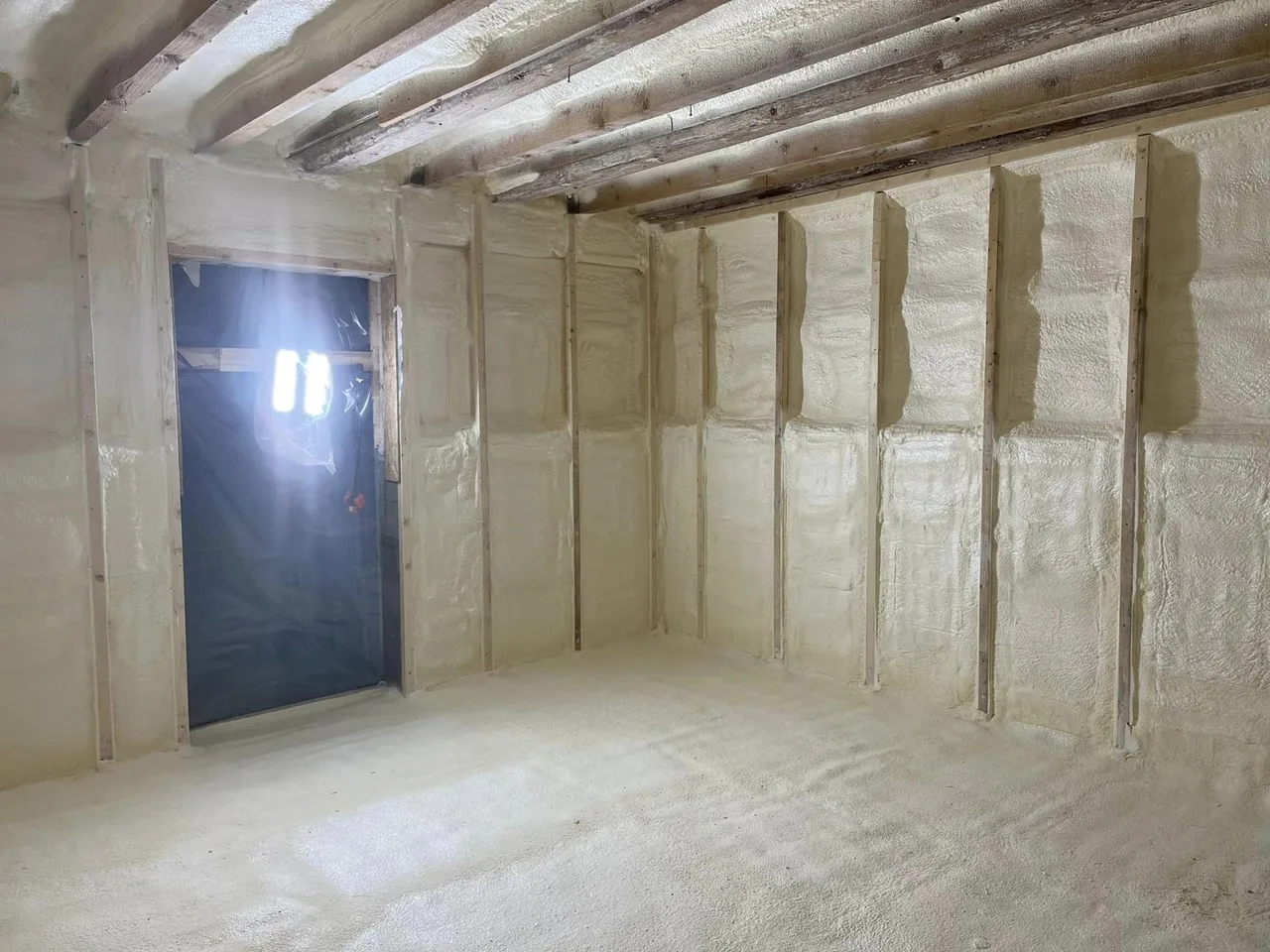
A foundation wall conducts heat straight into ground that stays cold and wet for much of the Oregon year. Insulating on the interior face with closed cell foam puts a continuous thermal and air barrier between the living space and that concrete, and because it adheres directly to an irregular surface it does so without the gaps that framed-and-batted basement walls almost always leave behind.
The Rim Joist Is the Quiet Culprit
Where the floor structure meets the foundation there is a band of framing, often uninsulated, often with gaps straight through to outside. It is one of the largest air leaks in a typical house and one of the least looked at. Sealing and insulating the rim joist is a small, contained piece of work with a noticeable result, and it is usually done at the same time as the walls.
Moisture Before Insulation, Always
Efflorescence on the concrete, damp patches, or water arriving after heavy rain all have to be understood before anything is applied to that wall. Closed cell foam is a vapour retarder, which is an advantage in a dry assembly and a way of hiding a problem in a wet one. If there is an active water issue we will say it comes first, because insulating over it only makes it harder to find later.
Finished and Unfinished Basements
An unfinished basement is straightforward: the walls and rim joist are accessible and the work is quick. A finished basement means the foundation wall is already covered, so the honest options narrow considerably and often come down to doing the work when the space is next opened up. We will tell you which situation you are in rather than quoting around it.
Questions
Common questions
Can I insulate a basement that gets damp?
Not until the moisture source is dealt with. Foam over an active water problem conceals it rather than solving it.
Is closed cell necessary, or will batts do?
Batts against a foundation wall tend to trap moisture and leave air gaps. Closed cell adheres to the concrete and handles vapour, which is why it is the usual recommendation here.
What about the rim joist?
It is usually part of the same job and often the single most worthwhile part of it.
Want to know what your project would cost?
Tell us about the property and we'll help you determine the next step.
Free written estimates • No obligation • Local team